Our vision of change management
Twisting steps in at the critical juncture where a scientific breakthrough or disruptive technology is proven, yet its adoption and societal impact remain uncertain.
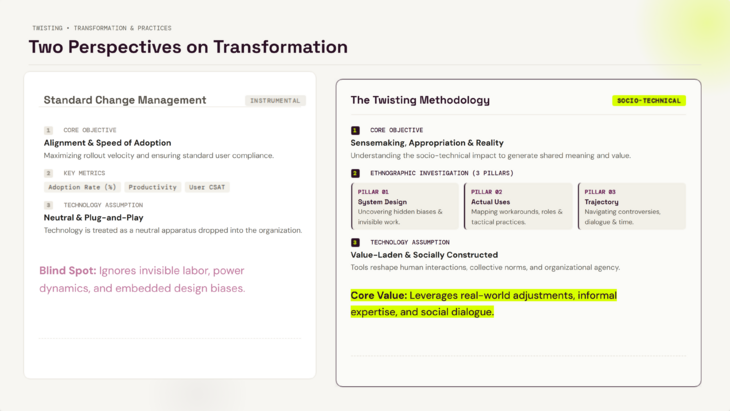
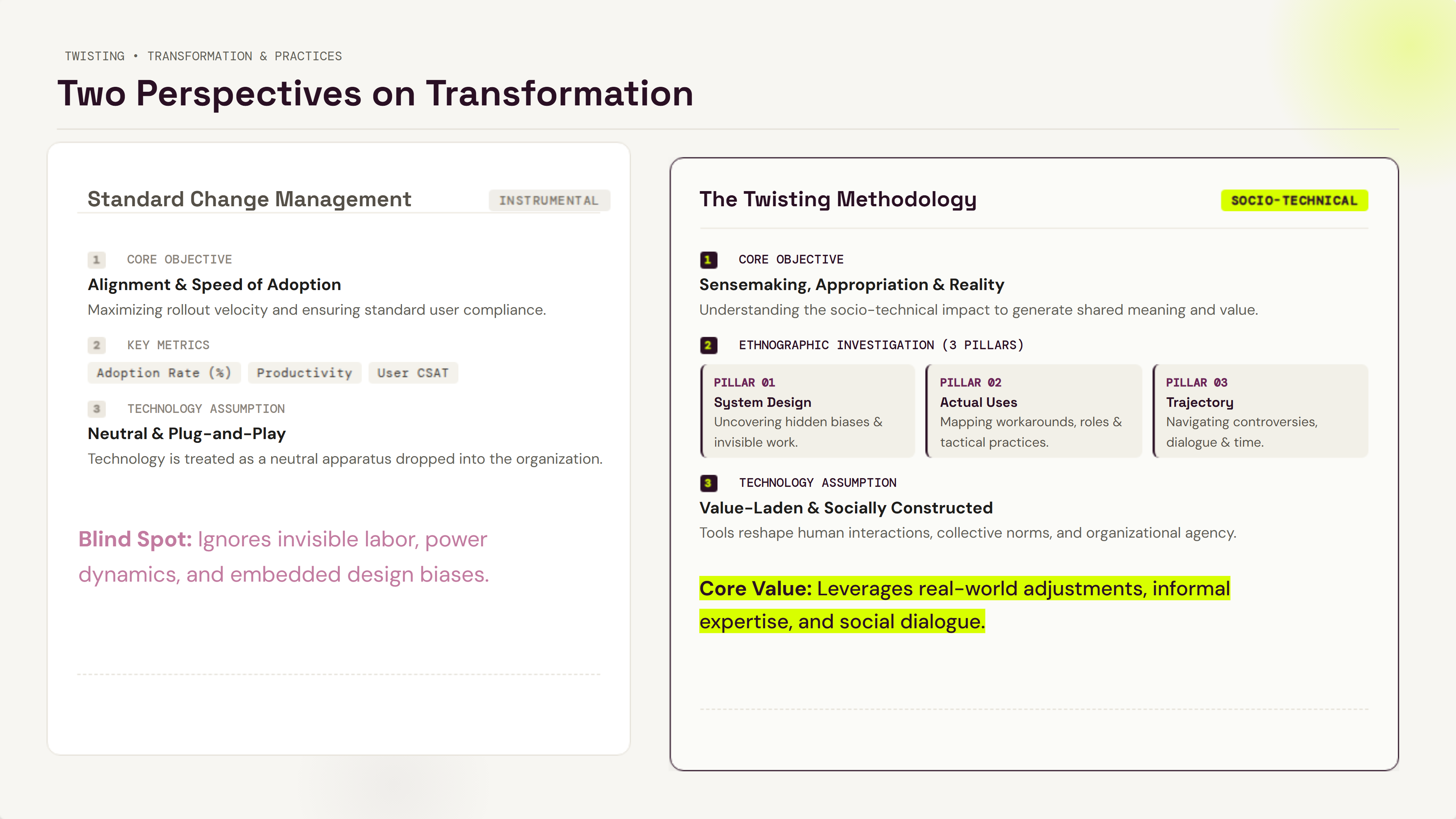
While traditional change management focuses on aligning people to tools through instrumental metrics (adoption rates, productivity KPIs, user satisfaction), Twisting takes a sociological approach to user practices and organizations. Rather than forcing tool adoption at all costs, the goal is to understand the reciprocal dynamic between the technical system and the workforce, thereby reducing uncertainty.
The objective is to move beyond a purely techno-push mindset and transform AI into a solution that is embraced, useful, and socially desirable. This methodology centers on three main pillars of empirical investigation, primarily driven by ethnographic field research.
Principle 1
Design Analysis and Decoding the Socio-Technical Chain
We first examine the origins of the system and how the technology is shaped by its creators well before deployment.
Translating expectations: Analyzing how software designers interpret, code, and model the needs, expectations, and constraints of future users—whether professionals or citizens. Rather than taking the tool as a given, this analysis investigates its technical genesis to identify potential disconnects between technical intent and ground realities.
Mapping invisible labor: Highlighting all the behind-the-scenes tasks essential to keeping AI running (data cleaning, labeling, maintenance, manual adjustments). Unlike traditional KPIs that only measure apparent productivity, this step sheds light on the new lines of collaboration required across the entire production chain to make the system meaningful.
We then examine how the tool interacts with actual practices within adopting organizations, evaluating how collective dynamics are reshaped.
Observing real-world use: Tracking how the tool is integrated into daily workflows to understand how teams adapt to it, find workarounds, or make it their own.
Reshaping hierarchies and roles: Analyzing how introducing AI redefines skill sets, shifts power dynamics and responsibilities, and sparks new patterns of collaboration or friction across teams.
Principle 2
Engaging with Real-World Work and Field Immersion
Principle 3
Reflective Assessment & Historical Context works
The final pillar anchors AI deployment over the long term and equips stakeholder dialogue to anticipate systemic risks.
Analyzing friction and controversies: Documenting moments of reflection, ethical or operational doubts, and pushback from various stakeholders regarding automated decision-making. Rather than being suppressed, these tensions are treated as essential weak signals.
Socio-historical trajectory and boundaries: Situating the technical system within the organization’s history to assess whether AI genuinely addresses structural challenges or merely serves as a temporary technoscientific fix for deeper uncertainties (techno-solutionism).
Twisting provides organizations with a strategic steering framework to foster informed stakeholder dialogue, defuse rejection risks, and navigate algorithmic disruptions with confidence.